

Restructuring the PMF Could Redraw Iraq’s Balance of Power
2026-06-061169 view
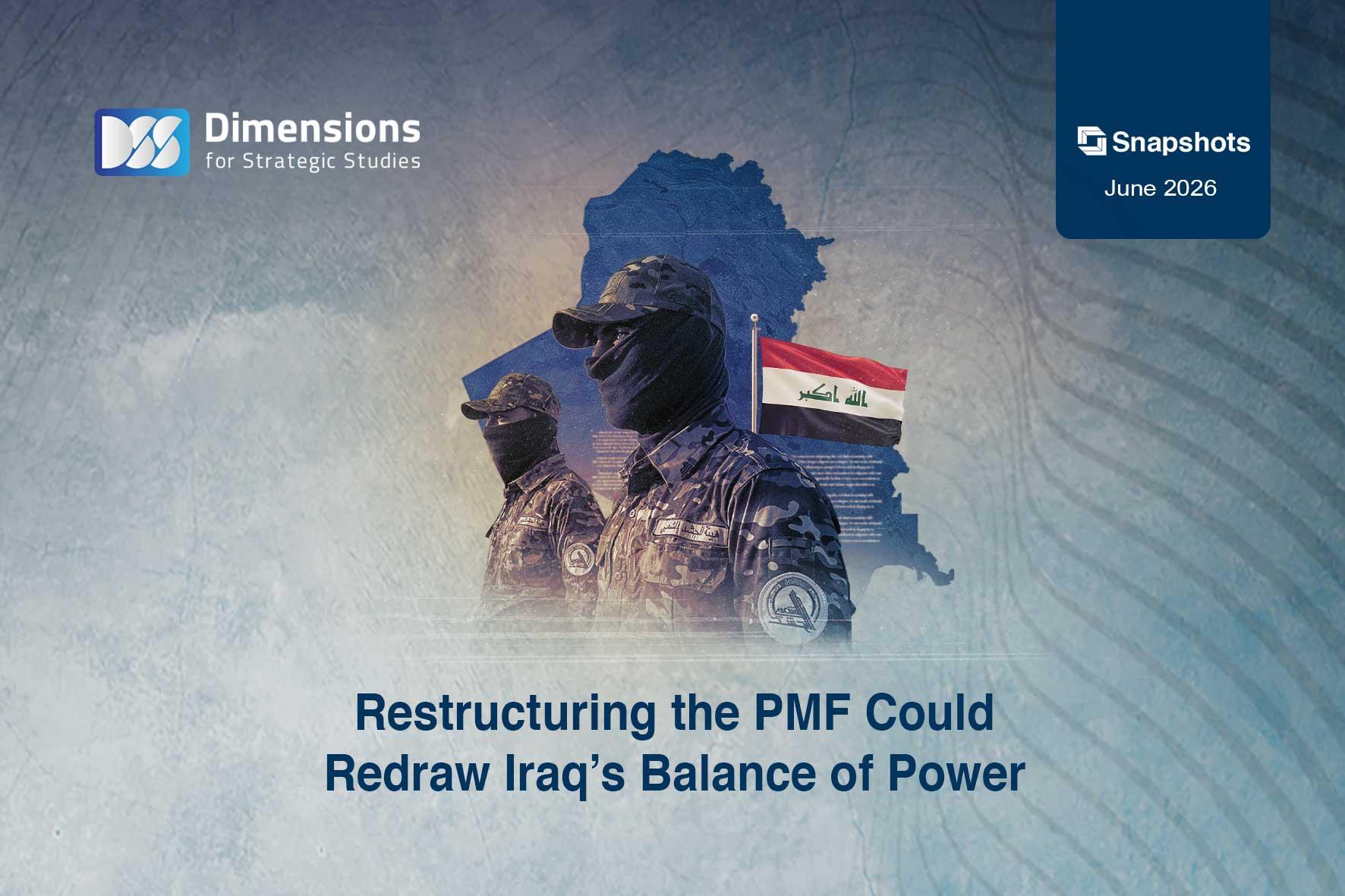
Steps by Iraq to remove some armed factions from the official umbrella of the Popular Mobilization Forces (PMF) represent a major turning point for the country. Rather than a minor reform of a security agency, it represents a drive to redefine the relationship between the state and various armed forces that have emerged over the past decade. As such, it has implications for the very future of Baghdad’s monopoly on the use of force and the distribution of influence among Iraqi Shiite political factions, with implications for regional and international balances of power.
Twelve years since the PMF was formed to fight the Islamic State-group, this drive represents the first serious attempt to push key factions to transition more explicitly from armed activity to political and institutional engagement. However, this shift does not necessarily imply that these factions will disappear or the completely lose their influence. Many have extensive political, social, and economic networks that may allow them to maintain their clout even if they relinquish some of their military functions. Therefore, success cannot be measured by political statements alone, but rather by the state’s ability to impose practical arrangements concerning weapons, leadership, funding, and organizational structure.
Accordingly, the Iraqi government appears to be taking a gradual approach that leans more on political understandings than confrontational measures, in order to avoid provoking a crisis within the Shiite community or pushing dissenting factions toward more hardline options. Furthermore, the existence of coordination mechanisms between political forces and PMF-linked actors reflects an understanding that any major shift requires internal consensus, to limit the potential for division or direct confrontation.
Conversely, engagement in the process by some of the PMF’s more than 60 factions is likely to increase pressure on others who have hitherto insisted on maintaining an arsenal beyond the reach of the state. The latter could thus be presented with a new political reality pitting them against former allies, adding to the political cost of the status quo. Yet for now, there is little evidence than a large-scale military confrontation is imminent. Rather, these factions may attempt to exert influence through political, media, and organizational means, to slow or alter the course of the transition process.
Among the most prominent challenges to the effort could be the emergence of smaller, more radical groups that reject the current compromises. Similar experiences elsewhere show that restructuring processes do not always result in the dismantling of all armed groups. They can push some elements to operate as less centralized networks that are more difficult to monitor and contain. This presents the Iraqi state with a dual challenge: addressing the root causes of fragmentation while preventing the transfer of weapons to new, unofficial channels.
Iran, which commands the loyalty of many PMF factions, is carefully watching developments and seeking to maintain its influence in Iraq, while avoiding open confrontation on the issue. Tehran appears inclined to adapt to the new reality by strengthening its political and economic influence, while preserving its relationships with its closest allies. At the same time, it recognizes that any decline in the official status of Iran-aligned factions in Iraq could affect its sphere of influence there, prompting it to seek to manage the transition rather than prevent it entirely.
For the U.S., the process is a practical test of the Iraqi state’s ability to assert its authority in security matters. Therefore, Washington will measure its success not by statements but by results: the extent to which the effort expands the state’s monopoly over the use of force and strengthens Baghdad’s control over the security apparatus.
In summary, Iraq is in embarking on a transitional phase that could redraw a years-old domestic balance of power. If it succeeds in seeing through genuine institutional reform, this could help establish the state’s monopoly on the use of force and consolidate the country’s political stability. However, if the measures remain limited or merely symbolic, the influence of these weapons could persist in new, less visible, and more complex forms. This could leave unresolved one of the most prominent challenges facing the Iraqi state since 2003.