

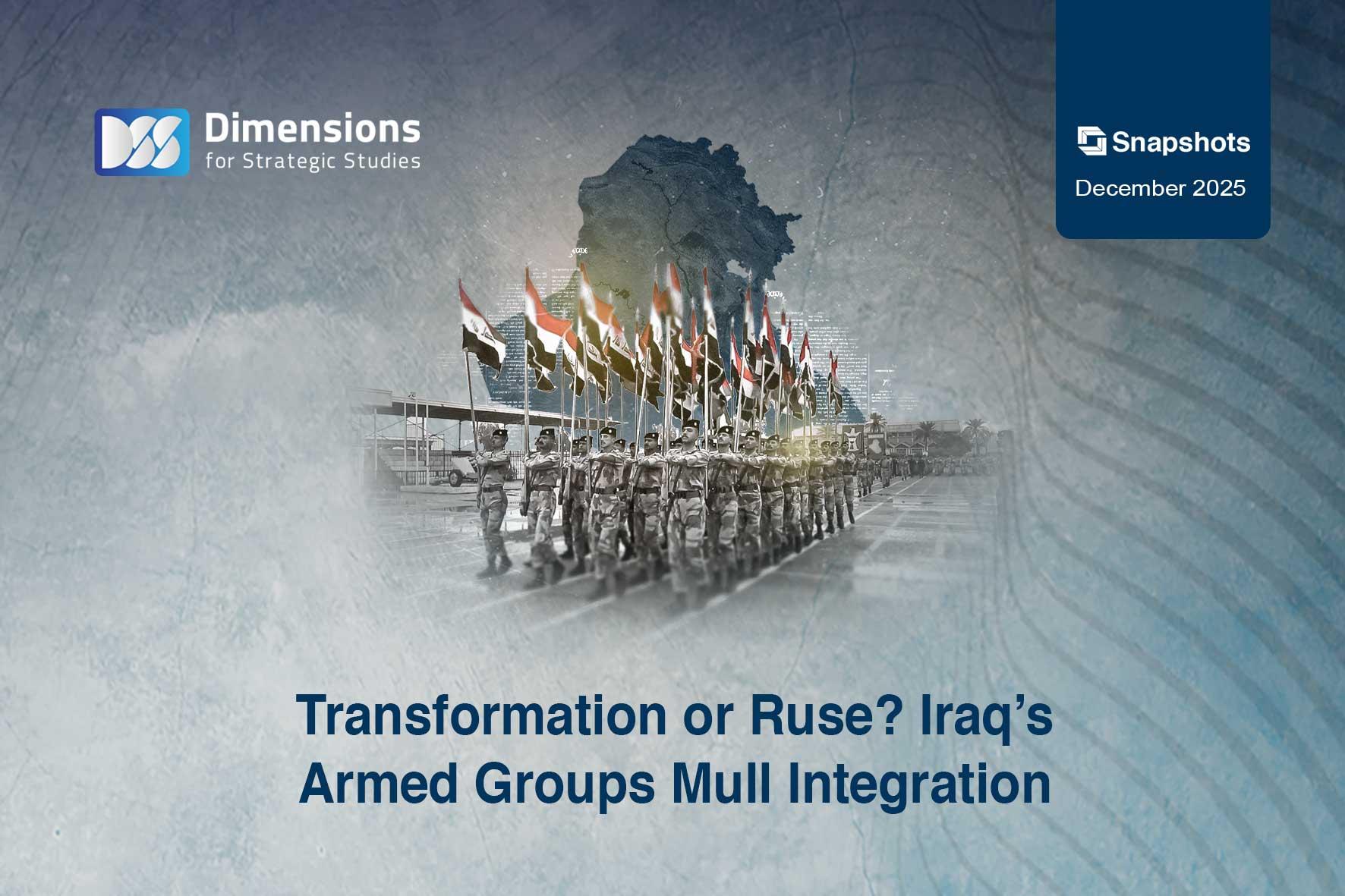
Transformation or Ruse? Iraq’s Armed Groups Mull Integration
2025-12-315786 view
In late December, several Iraqi armed groups announced they had agreed to a plan to place their weapons under the control of the Iraqi army. They included several key factions: Asa’ib Ahl al-Haq, Kata’ib al-Imam Ali, and the armed wing of the Hikma Movement.
By contrast, Kata’ib Hezbollah conditioned its disarmament on the withdrawal of foreign forces and provision of guarantees of the safety of Iraqis and their holy sites. Harakat al-Nujaba also rejected the plan.
The announcement came after months of behind-the-scenes pressure by the Trump administration on Iraqi armed factions and state institutions to impose a state monopoly on the use of force, restricting weapons to the army and security establishment—pressure backed up by threats of economic sanctions and military escalation.
The factions that agreed to the plan have been working for several years on a new approach, based not solely on a relationship with Iran, but on establishing a way for Shiite forces to ensure their survival, with Iraqi interests in mind. Conversely, the factions that rejected the plan are seen as the closest to Iran and the biggest recipients of Tehran’s support. Accordingly, their rejection of the disarmament plan reflects the position of the Islamic Republic.
Iran does not appear prepared at present to sacrifice its leverage in the Iraqi arena, which provides it with a key source of strategic depth and margin of maneuver in security, economic and political terms, especially given the possibility of a new Israeli attack. Furthermore, it cannot allow for its proxies in Iraq to be dismantled while its rivals and adversaries retain theirs—such as Turkish forces in northern Iraq and American forces in numerous locations.
Tehran is publicly pushing for armed factions to be integrated into the Iraqi army, but under its vision, this integration would not be genuine—rather, the groups would remain as cohesive blocs, maintaining their original structures. This would allow provide the factions with the protection of the army, without affecting their role or depriving Tehran of the ability to deploy them when necessary or create sense of threat emanating from Iraqi territory.
Washington is likely to gradually tighten the economic screws on Iraq’s armed groups, working to restrict their ability to exploit official institutions to evade U.S. sanctions and gradually hinder their capacity to provide financial support to their personnel. Furthermore, it will exert pressure to change up the leadership of the army and security institutions, removing commanders affiliated with the factions.
The Trump administration is also likely to take a harder stance, insisting that the prime minister be unaffiliated with the factions. It may even threaten tougher economic sanctions or challenge the legitimacy of the recent parliamentary elections, should the Coordination Framework political alliance select a candidate associated with the armed groups.
While the proliferation of weapons in Iraq outside of state control is unlikely to end any time soon, these pressures are likely to lead to changes in the situation, representing a new chapter in Washington’s ongoing effort to reduce Iran’s influence in Iraq.